Does Bark Wick?
In my various thoughts about feeding and watering orchids, the question about the delivery process often comes up.
In the articles about Instantaneous Nutrient Capture and Nutrient Uptake Rate, I wrote about roles of various parts of the roots – velamen, on in – at absorbing, capturing, and transferring water and nutrients to the plant. An aspect that had not been directly addressed, however, was how those stored in the potting medium are transferred to the roots.
Think of this scenario, using a bare-root plant as an example: if we water it with a “rain head” type device, the water droplets coming into contact with the roots are captured and absorbed, but the others pass right by and drop to the ground, being of no value to the plant. Shifting that scenario to include a potting medium, we now have moist medium to contend with, but the question remains as to whether a solution absorbed by the media particles ever reaches-, or in other words, is “wicked” to the roots.
As we have shown, several types of inorganic media, like lava rock, perlite (sponge rock), pumice, rock wool, and LECA (lightweight expanded clay aggregate), as well as sphagnum moss do a reasonable job of wicking solutions to the roots, but how about “bark”-based ones? With the help of a few other growers, I assembled a small array of such products; fir bark, “Kiwi Bark”, Orchiata, and some coconut husk chips (CHC).
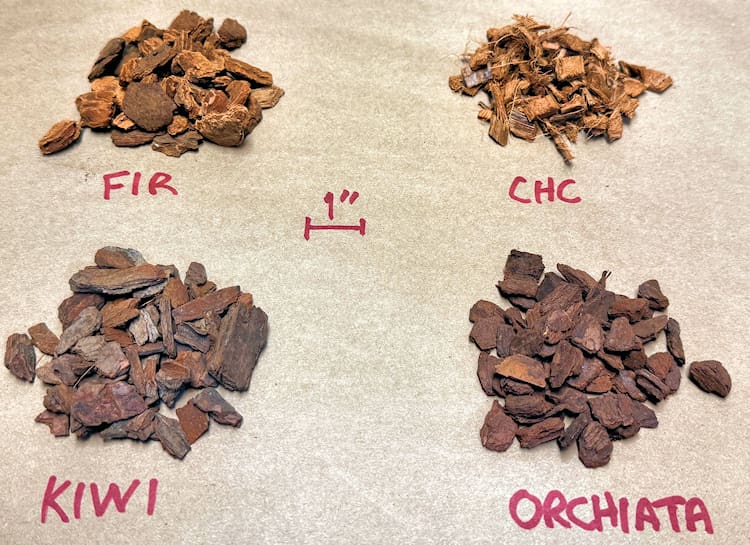
The bark-based products are close enough in size to lend themselves to a reasonable comparison, while the CHC is considerably finer, but it won’t hurt to look at that, as well. Here’s how they were avaluated:
- Each product was placed in a clear plastic container while being jostled and “banged” on a coutertop to densify them, as one might do when potting up a plant.
- Product was continued to be added until the 500 ml volume was filled before capping the containers.
- Each was weighed to estimate a bulk density.
Material | 500 ml Dry Weight (g) | Approx. Bulk Desity (g/L) |
Fir Bark | 138.3 | 277 |
Kiwi Bark | 144.9 | 290 |
Orchiata | 155.8 | 312 |
CHC | 65.8 | 132 |
- 50 ml of water was injected into each container via a hole drilled in the side, two inches above the bottom.
- The holes were taped-over to seal them and the bottles allowed to sit at room temperature.

With the containers sealed, there is no chance for evaporation, so only absorption and wicking come into play.
After 4 hours, none of the samples showed any indication of wicking watrer upwards in the column:
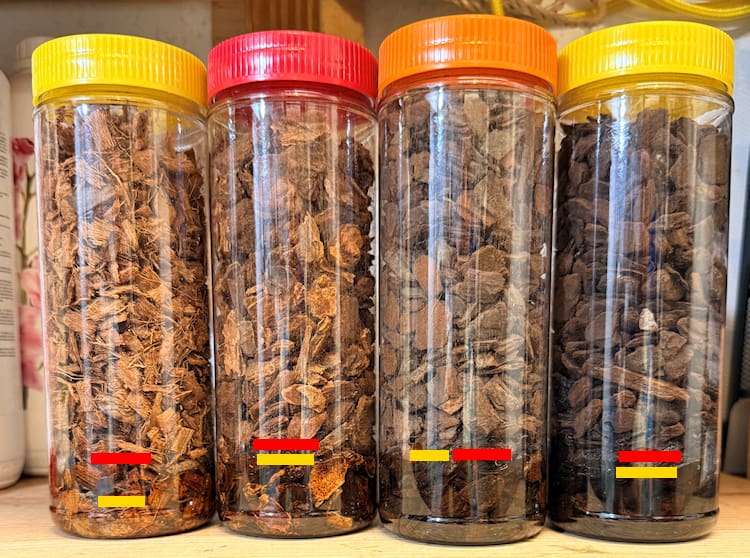
In this case, the red lines indicate the original water level and the yellow lines indicate the level 4 hours later. Darkening of the sample color indicates wetting and absorption. From left to right:
- CHC has absorbed the most water, as indicated by the reduction if the liquid level in the container.
- Fir Bark has absorbed a small volume.
- Kiwi bark shows very little reduction in the liquid level.
- Orchiata shows a similar absorption volume to that of the fir bark.
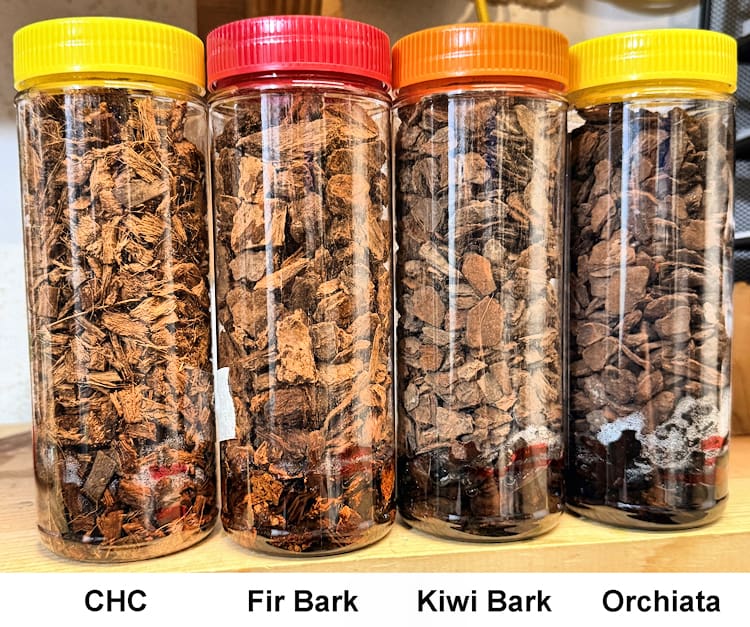
At 24 hours, the trends continued:
- Fir Bark: absorbed about 20% of the liquid, but has not wicked any upward above the wetted volume.
- Kiwi Bark: is wet, but absorption is unnoticeable, with no wicking.
- Orchiata: similar to fir bark, maybe absorbing a fraction more water, but still no wicking.
- CHC: absorbed all the water, but there is no evidence of it moving upward.
At 48 hours into the experiment, not further changes were noted:
Based upon these observations and those gleaned over 55+ years of using almost every potential potting medium known to mankind, my gut tells me that minimal wicking is a good indicator that very little of the water absorbed by particles adjacent to-, but not in direct contact with roots, ever get to the plant for absorption.
As far as I’m concerned, the velamen radicans is “just a sponge”, and if not saturated, will absorb any solution with which it makes contact. That means that the individual grower must make some educated decisions.
For me, I use media ingredients that wick well, but have them in a coarse enough grade that they are very airly with very little interstitial, ‘bridging water” held between particles. I “fine tune” to the needs of the plants by the frequency of watering. Another “tuning” method is to use a finer grade of less-absorbent medium – but one that holds a lot of bridging water, relying on that to carry the plant between waterings.
Unless you go too far in either direction, there really isn’t a “wrong answer”, you just need to fins the one that’s right for you, your growing conditions, and the plant.
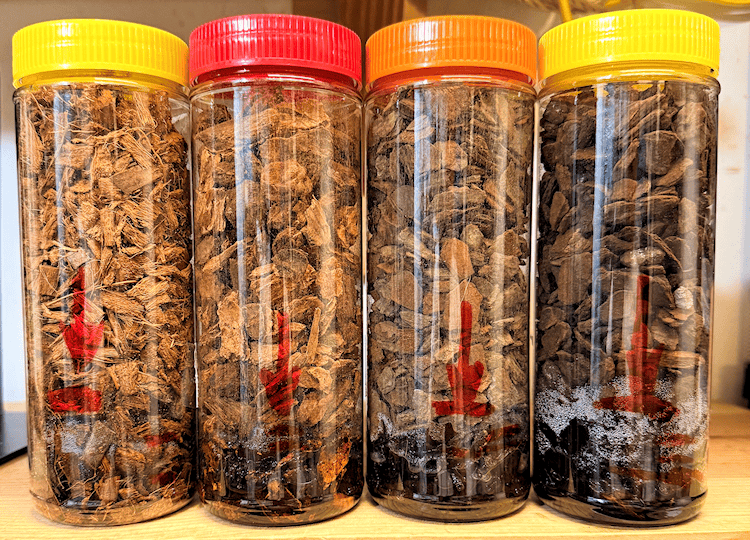
As a final confirmation that the wicking is quite poor, below is a photo of the materials after two weeks – long enough that the water would be long-since evaporated in a growing container. The arrows indicate the maximum wicking elevation.