
Practical Use of Daily Light Integral
If you’ve been growing a long time, you probably started your understanding of light needs by reading the AOS Culture Guides. They typically provided the foot-candles of light intensity the plants could handle. What they failed to state, however, that those values were the peak, noontime intensities the plants should get, not a constant value, and that threw off folks growing under lights. Our article on Light Level Recommendations helps the grower with that, but there is newer and better information about light levels available.
Just as plants must take up a certain amount of nutrition and water, they must also absorb a certain amount of photons of light to provide the energy needed to drive photosynthesis, and subsequently, all the plants’ phytochemical processes. The intensity of those photons – the number per unit time – and the duration to which that happens in a day, combine to define the total number of photons absorbed – the DLI. A simple analogy is allowing rain to fill a bucket. Light intensity is how hard the rain is falling right now, while DLI is how much water ends up in the bucket by the end of the day. Just as a short, heavy rainstorm and a long, light drizzle can fill the bucket to the same level, short periods of high light intensity and longer periods of lower intensity can provide the same number of photons.
Water demand is measured by liquid volume – gallons or liters, for example. Nutritional demand is measured by mass of nutrients – milligrams. Light is measured in moles of photons per unit area per unit time. A “mole” is 6.022 x 10²³ (a LOT of photons!) and the DLI is expressed as moles/m2/day.
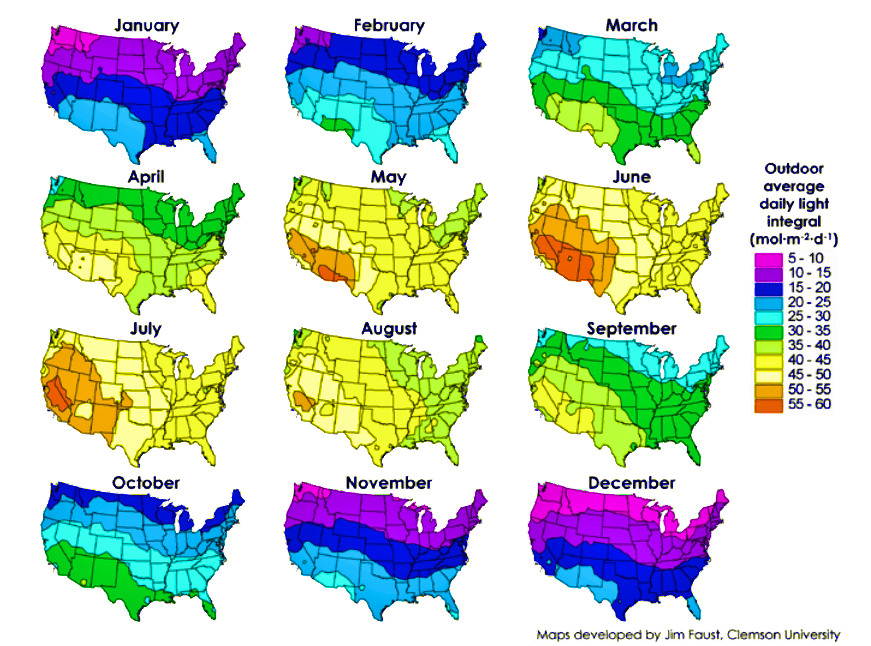
The DLI of natural sunlight varies geographically and seasonally:
Here are some generalized DLI levels for orchids:
Orchid Genus / Type | Typical DLI Range (moles/square meter/day) | Light Category |
Ascocenda | 20 - 30 | Very High |
Brassavola | 14 - 20 | High |
Brassia | 8 - 12 | Medium |
Bulbophyllum | 4 - 8 | Low |
Cattleya | 12 - 18 | Medium-High |
Cymbidium | 16 - 24 | High |
Dendrobium (nobile types) | 14 - 20 | Medium-High |
Dendrobium (phalaenopsis types) | 10 - 16 | Medium |
Dracula | 3 - 6 | Very Low |
Laelia | 14 - 20 | High |
Masdevallia | 4 - 7 | Low |
Miltonia | 8 - 12 | Medium |
Miltoniopsis | 6 - 9 | Low-Medium |
Oncidium (most) | 8 - 14 | Medium |
Paphiopedilum | 4 - 8 | Low |
Phalaenopsis | 4 - 8 | Low |
Phragmipedium | 6 - 10 | Low-Medium |
Vanda | 18 - 30 | Very High |
Zygopetalum | 8 - 12 | Medium |
We can use the chart and the maps to estimate the percentage of shade cloth we might need in the middle of summer or to determine how much supplemental light might be necessary in the dead of winter.
For example, let’s consider growing vandas here in southeastern North Carolina. According to the chart, they should receive a DLI of about 25 moles/m2/day, and the maps indicate that my summer sunlight DLI levels are typically around 45 moles/m2/day. That suggests that I should place the plants under shade that blocks about (1-25/45) or about 50% of the direct sun. In the winter, however, my natural light DLI is about of 20 moles/m2/day, so a small amount of supplemental light would be in order.